Official government website of the Government of the Kingdom of Saudi Arabia
Official Saudi educational websites URL ends with edu.sa
Website belongs to an official educational in the Kingdom of Saudi Arabia always ends with .edu.sa
Government websites use the HTTPS protocol for encryption and security.
Secure websites in the Kingdom of Saudi Arabia use the HTTPS protocol for encryption.
Registered with the Digital Government Authority under number:
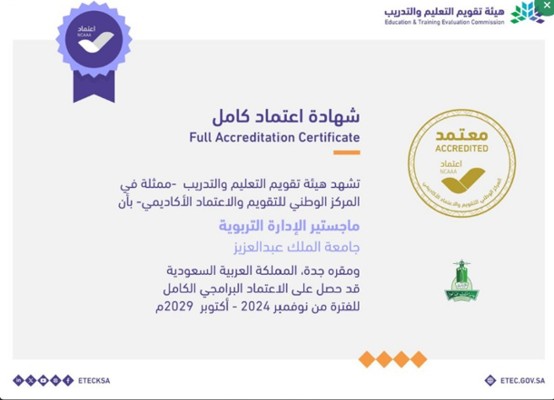
20260412890The Master of Educational Leadership Program, offered by the Department of Educational Leadership and Policies in the College of Education, is designed to prepare qualified educational leaders capable of addressing contemporary challenges in the field of education. Beginning with the 1441/1442 AH academic year, admission and enrollment were opened for the program under the coursework-and-thesis option. The program is closely aligned with the prevailing trends in graduate education in the Kingdom of Saudi Arabia and is intended to meet the practical and professional needs of stakeholders serving in educational roles.
To become a pioneering academic authority in preparing and qualifying educational leaders and fostering high-quality research and knowledge production in the field of educational administration
To prepare educational leaders equipped with the competencies required to lead educational institutions, enhance professional practice, utilize professional and research activities to address administrative and educational challenges, and contribute to community service and the achievement of its developmental aspirations.
Last Modified Date: 08/10/2026 - 9:33 PM Saudi Arabia Time
| Course Code | Course | Credits | Prerequisites |
|---|---|---|---|
| EDAD 610 | Comparative Educational Administration | 3 | None |
| Description | This course examines the general organizational structure of education in the Kingdom of Saudi Arabia through a comparative analysis of educational organizational systems in the Gulf Cooperation Council (GCC) countries, other Arab nations, and selected Islamic and international contexts. It explores these systems from historical and philosophical perspectives, highlighting the prevailing orientations and policies that shape educational governance and development. The course also provides an in-depth understanding of the policy frameworks and strategic directions guiding education within these educational systems. | ||
| EDAD612 | Educational Institution Management | 3 | None |
| Description | This course examines the historical development of management, its models, schools of thought, and major pioneers. It focuses on the concepts of management and educational administration, including their objectives, functions, fields, and theories. The course also explores educational authorities and their organizational structures, leadership theories, and the essential skills required of educational leaders. In addition, it covers authority and responsibility, decision-making, organizational management, and educational supervision. | ||
| EDUC 600 | Inferential Statistics | 3 | None |
| Description | This course addresses the topics necessary for formulating and statistically testing hypotheses using appropriate statistical methods (whether parametric or non-parametric, according to the size and nature of the data) with the SPSS program. It presents the relevant information in a logical sequence, building the course step by step so as to provide the knowledge the student needs at this stage, both theoretically and practically. | ||
| EDUC 601 | Computers in Education | 3 | None |
| Description | This course aims to familiarize students with the characteristics of the computer and its uses in the educational process; the advantages of its use; the guidelines to be followed when teaching with the computer; the rationale for its use; the classification of computer software; the roles of the computer in education and its applications; teaching and learning with multimedia; educational computer software and how to evaluate it; innovations in the field of instructional computing; e-books and how to design, produce, and classify them; as well as understanding e-learning and its modes. | ||
| 613 EDAD | Educational Planning | 3 | None |
| Description | The course examines educational planning as one of the fundamental components of educational administration and explores its role in improving the educational process and achieving efficiency, effectiveness, and quality. It emphasizes the importance of planning in enhancing educational outcomes and aligning them with community needs and labor market requirements, while promoting educational equity by reducing disparities among different regions and ensuring equal learning opportunities for all. The course also addresses the role of educational planning in forecasting future needs, supporting sustainable development, improving the effective utilization of educational resources, and promoting innovation and the integration of modern technologies in education. Furthermore, it highlights the importance of planning in coordinating various educational efforts and developing flexible and inclusive educational pathways capable of responding to future challenges and changes. | ||
| EDUC 603 | Evaluation of Educational Programs | 3 | None |
| Description | This course addresses the concept of educational evaluation and its simulations, models, and tools, and the international standards for evaluating modern educational technologies. It reviews standards for digital content, accessibility, usability, digital intellectual property, and the environmental operation of systems, in addition to explaining electronic evaluation and its tools, software, and simulations and the most important rating scales, as well as evaluating some modern technologies such as multimedia software, course-delivery systems, social networks, and virtual-reality environments. | ||
| EDUC 694 | Research Methods in Education | 3 | None |
| Description | This course focuses on the knowledge and skills related to scientific research in the field of educational technology. It addresses in detail how to use quantitative, qualitative, and mixed methods and employ them in educational-technology research; training in the methodological steps for each type of research; and the practice of applied skills related to defining the research problem, research objectives and hypotheses, the significance of the research, analysis of previous studies, selection of the research sample, managing the relationships among variables, methodological designs, measurement and data collection, interpretation of results, and the use of theories. The course also addresses the use of digital reference-management software and tools such as EndNote, quantitative data analysis using SPSS, qualitative data analysis using MAXQDA, and plagiarism avoidance using iThenticate, in addition to using the analytics of electronic databases to reach accurate research findings. | ||
| EDAD 3hours | Name | 3 | None |
| Description | Name | ||
| EDUC 695 | Research Seminar | 3 | EDUC 694 |
| Description | This course addresses selected issues and problems in educational technology and how to approach them scientifically through the preparation of a research plan submitted by the student. These plans are discussed to ensure adherence to sound scientific-research methods, and are then developed into research projects. | ||
| EDUC 602 | Readings in Educational Technology in English | 3 | None |
| Description | This course includes readings of scientific research, topics, and articles in the field of education in general and educational technology in particular in the English language, together with their translation and discussion; describing their objectives and their research methods and approaches; an analytical reading of their results and of the recent trends related to them; extracting the specialized scientific terminology in the field of educational technology; and writing a report on them in English. | ||
| 611EDAD | Economics of Education | 3 | None |
| Description | The course provides an introduction to the field of Economics of Education, covering its development, relationship with other disciplines, and major areas of research. It also examines educational expenditure, methods of financing education, approaches to estimating educational costs and economic returns, and methods for determining economic efficiency in education. In addition, the course addresses the economics of quality and knowledge, internal and external educational inputs and productivity, with a focus on the context of Economics of Education in the Kingdom of Saudi Arabia. | ||
| EDAD 615 | Professional Ethics | 3 | None |
| Description | This course introduces students to the principles and values that should characterize professionals working in the field of educational administration and highlights the benefits of adhering to these principles for society as a whole. It achieves this by fostering a deeper understanding of the two primary sources of Islamic guidance, the Holy Qur’an and the Prophet’s Sunnah, and by examining the administrative principles, ethical foundations, and professional values derived from them and their applications in educational leadership and administration. | ||
| EDAD 698 | Research Project | 3 | EDUC 695 |
| Description | This course enables students to undertake an original and innovative scholarly study addressing an educational issue or problem within their area of specialization. Through this work, students are expected to demonstrate a sound understanding of scientific research methodology and the ability to apply the theories, concepts, and foundations acquired throughout their studies. The course further emphasizes independent inquiry and critical analysis, with the ultimate aim of contributing to the improvement and advancement of educational practice. | ||
| EDAD 3hours | Name | 3 | None |
| Description | Name | ||
Course Code: EDAD 610
Description
This course examines the general organizational structure of education in the Kingdom of Saudi Arabia through a comparative analysis of educational organizational systems in the Gulf Cooperation Council (GCC) countries, other Arab nations, and selected Islamic and international contexts. It explores these systems from historical and philosophical perspectives, highlighting the prevailing orientations and policies that shape educational governance and development. The course also provides an in-depth understanding of the policy frameworks and strategic directions guiding education within these educational systems.
Course Code: EDAD612
Description
This course examines the historical development of management, its models, schools of thought, and major pioneers. It focuses on the concepts of management and educational administration, including their objectives, functions, fields, and theories. The course also explores educational authorities and their organizational structures, leadership theories, and the essential skills required of educational leaders. In addition, it covers authority and responsibility, decision-making, organizational management, and educational supervision.
Course Code: EDUC 600
Description
This course addresses the topics necessary for formulating and statistically testing hypotheses using appropriate statistical methods (whether parametric or non-parametric, according to the size and nature of the data) with the SPSS program. It presents the relevant information in a logical sequence, building the course step by step so as to provide the knowledge the student needs at this stage, both theoretically and practically.
Course Code: EDUC 601
Description
This course aims to familiarize students with the characteristics of the computer and its uses in the educational process; the advantages of its use; the guidelines to be followed when teaching with the computer; the rationale for its use; the classification of computer software; the roles of the computer in education and its applications; teaching and learning with multimedia; educational computer software and how to evaluate it; innovations in the field of instructional computing; e-books and how to design, produce, and classify them; as well as understanding e-learning and its modes.
Course Code: 613 EDAD
Description
The course examines educational planning as one of the fundamental components of educational administration and explores its role in improving the educational process and achieving efficiency, effectiveness, and quality. It emphasizes the importance of planning in enhancing educational outcomes and aligning them with community needs and labor market requirements, while promoting educational equity by reducing disparities among different regions and ensuring equal learning opportunities for all. The course also addresses the role of educational planning in forecasting future needs, supporting sustainable development, improving the effective utilization of educational resources, and promoting innovation and the integration of modern technologies in education. Furthermore, it highlights the importance of planning in coordinating various educational efforts and developing flexible and inclusive educational pathways capable of responding to future challenges and changes.
Course Code: EDUC 603
Description
This course addresses the concept of educational evaluation and its simulations, models, and tools, and the international standards for evaluating modern educational technologies. It reviews standards for digital content, accessibility, usability, digital intellectual property, and the environmental operation of systems, in addition to explaining electronic evaluation and its tools, software, and simulations and the most important rating scales, as well as evaluating some modern technologies such as multimedia software, course-delivery systems, social networks, and virtual-reality environments.
Course Code: EDUC 694
Description
This course focuses on the knowledge and skills related to scientific research in the field of educational technology. It addresses in detail how to use quantitative, qualitative, and mixed methods and employ them in educational-technology research; training in the methodological steps for each type of research; and the practice of applied skills related to defining the research problem, research objectives and hypotheses, the significance of the research, analysis of previous studies, selection of the research sample, managing the relationships among variables, methodological designs, measurement and data collection, interpretation of results, and the use of theories. The course also addresses the use of digital reference-management software and tools such as EndNote, quantitative data analysis using SPSS, qualitative data analysis using MAXQDA, and plagiarism avoidance using iThenticate, in addition to using the analytics of electronic databases to reach accurate research findings.
Course Code: EDAD 3hours
Description
Name
Course Code: EDUC 695
Description
This course addresses selected issues and problems in educational technology and how to approach them scientifically through the preparation of a research plan submitted by the student. These plans are discussed to ensure adherence to sound scientific-research methods, and are then developed into research projects.
Course Code: EDUC 602
Description
This course includes readings of scientific research, topics, and articles in the field of education in general and educational technology in particular in the English language, together with their translation and discussion; describing their objectives and their research methods and approaches; an analytical reading of their results and of the recent trends related to them; extracting the specialized scientific terminology in the field of educational technology; and writing a report on them in English.
Course Code: 611EDAD
Description
The course provides an introduction to the field of Economics of Education, covering its development, relationship with other disciplines, and major areas of research. It also examines educational expenditure, methods of financing education, approaches to estimating educational costs and economic returns, and methods for determining economic efficiency in education. In addition, the course addresses the economics of quality and knowledge, internal and external educational inputs and productivity, with a focus on the context of Economics of Education in the Kingdom of Saudi Arabia.
Course Code: EDAD 615
Description
This course introduces students to the principles and values that should characterize professionals working in the field of educational administration and highlights the benefits of adhering to these principles for society as a whole. It achieves this by fostering a deeper understanding of the two primary sources of Islamic guidance, the Holy Qur’an and the Prophet’s Sunnah, and by examining the administrative principles, ethical foundations, and professional values derived from them and their applications in educational leadership and administration.
Course Code: EDAD 698
Description
This course enables students to undertake an original and innovative scholarly study addressing an educational issue or problem within their area of specialization. Through this work, students are expected to demonstrate a sound understanding of scientific research methodology and the ability to apply the theories, concepts, and foundations acquired throughout their studies. The course further emphasizes independent inquiry and critical analysis, with the ultimate aim of contributing to the improvement and advancement of educational practice.
Course Code: EDAD 3hours
Description
Name