Website belongs to an official educational in the Kingdom of Saudi Arabia always ends with .edu.sa
Secure websites in the Kingdom of Saudi Arabia use the HTTPS protocol for encryption.
Registered with the Digital Government Authority under number:
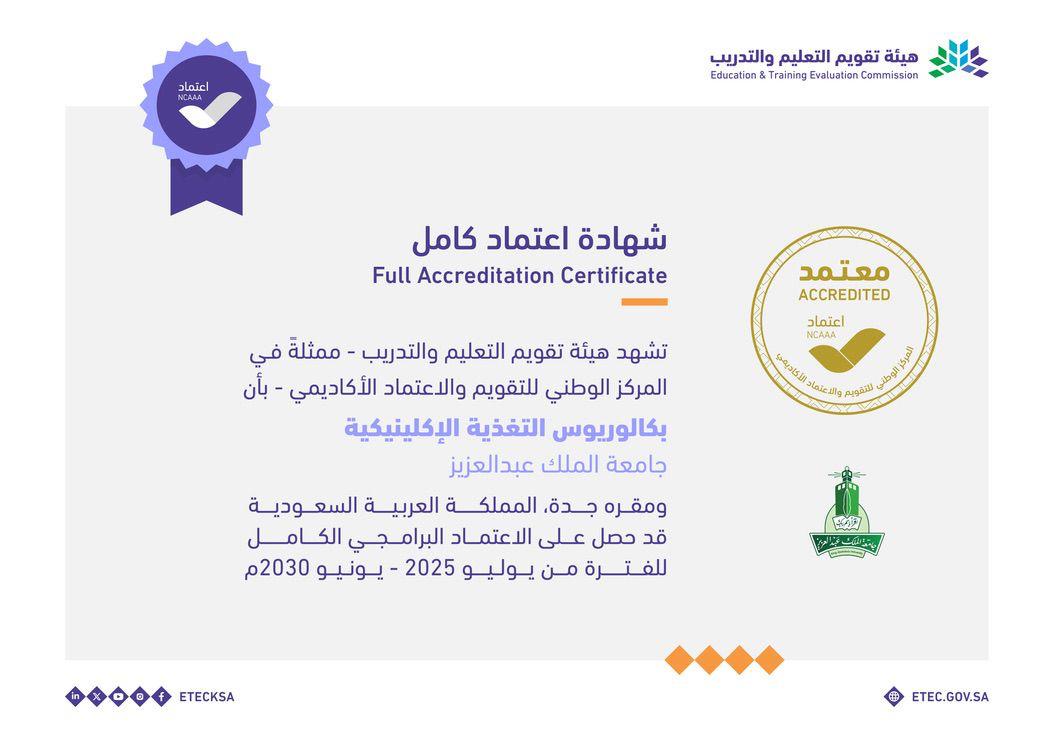
20260412890The Bachelor of Clinical Nutrition program aims to prepare scientifically and professionally qualified graduates to promote health and prevent diseases, in addition to contributing to comprehensive nutritional management for individuals, patients, and the community. The program emphasizes the integration of evidence-based nutrition sciences with applied clinical training to meet the needs of the national healthcare sector and to enable graduates to contribute effectively to hospitals and various healthcare facilities. The program is offered to both male and female students over a five-year period, beginning with a preparatory year, followed by three years that include specialized theoretical and practical courses, and concluding with a fifth year (Internship Year) dedicated to intensive clinical training in healthcare settings. This structure enhances graduates’ readiness for professional practice and successful integration into the workforce.

Leadership and innovation in the field of clinical nutrition
To produce entry-level registered dietitians who adhere the national and international standards of education, research, community services to improve the health of individuals and populations.
| Course Code | Course | Credits | Prerequisites |
|---|---|---|---|
| CLN349 | Food & Drug Interactions | 2 | – |
| Description | This course will teach the basic aspects of pharmacology that helps student to identify the drug food interaction. Additionally, this course will enable students to clinically evaluate and avoid drug food interactions. During this course the clinical nutrition students will gain the essential knowledge that help guiding them during their future clinical practice. | ||
| CLN-471 | Management Practice in Dietetics | 2 | – |
| Description | This course focuses on the aspects of management practice in dietetics, which includes managing an organization, tools for the managers, managing human resources, food, equipment, facilities, and financial resources. This course also covers managerial skills such as leadership, decision- making, and communication skills in the food service or clinical nutrition. | ||
| CLN 220 | Food science (1) | 3 | CHEM110 |
| Description | The main purpose of the course is to teach the categories and properties of food commodities and food products that make up our diet. The course will also include an overview about advanced approaches and technologies to preserve and improve both food quality and safety. | ||
| CLN334 | Nutritional Immunology | 2 | – |
| Description | The course consists of lectures on basic principles of immunology and mechanisms of immune response, as well as the impact of nutrients and nutritional status on immunity and critically evaluating the literature with respect to claims of the effects of nutrients on immune responses. | ||
| CLN348 | Enteral & Parenteral Nutrition support | 3 | CLN345 |
| Description | The course is intended to cover the current methods for the enteral and parenteral nutrition therapy including indications, contraindications, types of feeding, feeding access, initiation, method of administration, complications, monitoring, and management. | ||
| CLN460 | Research Project and Seminar (1) | 3 | MLT394 |
| Description | The course involves the study and application of the basic concepts of research methods in health sciences, such as the research process, project planning, literature review in health sciences, formulating study objectives, postulating hypotheses, research methodology, data collection, basic statistical analysis, presentation and publication. The course also comprises core concepts and challenges within ethics. | ||
| CLN484 | Clinical Rotation in Medical Nutrition Therapy (2) | 5 | CLN480 |
| Description | The course provides an opportunity for senior students to apply theories and concepts learned in an academic environment to real-life clinical settings, preparing them for the upcoming internship year and ensuring their readiness to practice their profession after completing the program. The course involves development of various skills required for the nutrition and dietetic profession, including effective communication with hospital staff, appropriate interaction with patients, assessment and analysis of medical data, planning nutritional management strategies for the recruited case studies, making evidence-based decisions, and professional documentation of nutritional assessment and management plans. During the hospital rotations, the students will be assigned into groups using [Peer Assisted learning (PAL)] approach throughout the entire semester. Senior students will be guided in their learning using a combination of guidance, observations, discussions and evaluation of conducted patients’ data and completed tasks and activities. This will be through the pre-assigned readings, morning meetings, in-class meetings, feedback, debriefings, reflections. | ||
| CLN435 | Nutritional Psychology | 2 | CLN346 |
| Description | This course involves the study of health psychology as it relates to human nutrition. It covers important definitions and historical background, personal and environmental determinants of behavior, associations of macro- and micronutrients and physical activity with psychological health and psychological disorders. This course includes the study of eating disorders and the development of eating behaviors among children. | ||
| CLN240 | Nutritional Status Assessment | 3 | CLN231 , CLN231 |
| Description | This course provides student the scientific knowledge to assess the nutritional status of the community and hospitalized patients. Students will gain an understanding of dietary, biochemical, anthropometric and clinical determinants used in the assessment of individuals and groups. | ||
| CLN346 | Medical Nutrition Therapy (2) | 5 | CLN345 |
| Description | This course is an integration of pathophysiology, biochemistry, and nutrition principles that form the basis for medical nutrition therapy in health care. Students will study the role of food and nutrition in the management of various diseases and conditions. | ||
| CLN351 | Global Food Security | 2 | – |
| Description | This course introduces the main global food problems (hunger, malnutrition and famine) and health-related effects common to the developing versus developed countries in the globalization context. It explores barriers to food production and availability. It discusses the role of research, agriculture development, international trade in the setting up of a global strategy towards sustainable food production. | ||
| CLN322 | Food Microbiology & Hygiene | 3 | CLN220 |
| Description | This course introduces the fundamental principles of food microbiology and hygiene with emphasis on microorganisms associated with foodborne diseases and food spoilage. It covers sources of food contamination, microbial growth and control, food preservation methods, and food safety systems. The course also highlights the application of food hygiene practices in clinical and healthcare settings, particularly in hospital food services and patient safety, with practical exposure to basic microbiological techniques and safe food handling relevant to clinical nutrition practice. | ||
| CLN480 | Clinical Rotation in Medical Nutrition Therapy (1) | 5 | CLN346 |
| Description | The course provides an opportunity for senior students to apply theories and concepts learned in an academic environment to real-life clinical settings, preparing them for the upcoming internship year and ensuring their readiness to practice their profession after completing the program. The course involves development of various skills required for the nutrition and dietetic profession, including effective communication with hospital staff, appropriate interaction with patients, assessment and analysis of medical data, planning nutritional management strategies for the recruited case studies, making evidence-based decisions, and professional documentation of nutritional assessment and management plans. During the hospital rotations, the students will be assigned into groups using [Peer Assisted learning (PAL)] approach throughout the entire semester. Senior students will be guided in their learning using a combination of guidance, observations, discussions and evaluation of conducted patients’ data and completed tasks and activities. This will be through the pre-assigned readings, morning meetings, in-class meetings, feedback, debriefings, reflections. | ||
| CLN 231 | Principles of Nutritional Science | 3 | BIO110 , CHEM110 |
| Description | This course aims to explore the roles of carbohydrates, lipids, proteins, vitamins, minerals, and water in the human body. Also, it explains nutrition standards and relationship between other related nutrients as well as requirements, the need for stable health, deficiency and consequence of over-consumption. | ||
| CLN345 | Medical Nutrition Therapy (1) | 5 | PATT205 , ANATT205 , CLN 233 , CLN232 , CLN240 |
| Description | This course is an integration of pathophysiology, biochemistry, and nutrition principles that form the basis for medical nutrition therapy in health care. Students will study the role of food and nutrition in the management of various diseases and conditions. | ||
| CLN347 | Nutrition Counseling and Education | 3 | CLN 233 , CLN240 |
| Description | Effective nutrition interventions depend on evidence-based theories, models, and strategies put into practice. This course will review evidence-based theories used in planning and delivering nutrition communications and counseling. | ||
| CLN350 | Nutritional Epidemiology | 2 | – |
| Description | This course introduces principles of epidemiology and measures of diseases. The course highlights the importance of nutritional epidemiology in health and provide a critical approach with recent trials carried in the Kingdom. | ||
| CLN233 | Nutrition During Life Cycle | 4 | PHYT205 , CLN231 |
| Description | This course covers assessing nutritional needs of individuals at different stage of the life considering the effect of biological changes, lifestyle factors, and health conditions on the nutritional requirements in normal development and maintaining health. | ||
| CLN221 | Food science (2) | 2 | CLN 220 |
| Description | The purpose of this course is to expose students to the principles, methods, and techniques of qualitative and quantitative physical, chemical and biochemical analysis of foods. Students will perform experiments to determine major food components using chemical and instrumental methods. Government regulations and standards related to food quality and labelling will be presented in this course | ||
| CLN481 | Genetic & Metabolic Nutritional Disorders | 3 | CLN346 |
| Description | The course covers the principle of nutrigenetics, nutrigenomics, nutritional epigenomics, as well as the medical nutrition therapy related to some genetic & metabolic disorders such as inborn errors of protein, carbohydrate, and lipid metabolism. | ||
| CLN482 | Medical Nutrition Therapy in Pediatric | 3 | CLN346 , CLN348 |
| Description | This course involves describing the pathophysiology of the different pediatric nutritional related disorders & their implications for nutritional care; Evaluation of the nutritional status of children with a variety of pediatric diseases; Development of nutrition plans for chronic pediatric diseases affecting nutritional status; Application of the NCP in pediatrics with a variety of pediatric diseases and calculation of nutrient requirements for selected diseases in pediatrics; Interpretation of the nutritional assessment information; Discussion of roles of diet in disease progression, prevention, and nutritional management. | ||
| CLN470 | Professional Practice in Dietetics | 2 | – |
| Description | This course provides detailed information on the role of dietitian in modern health care system and the application of interviewing, counseling, and educational techniques in dietetics. | ||
| CLN232 | Nutritional Biochemistry and Metabolism | 3 | MLS201 |
| Description | This course will explore the importance of nutritional biochemistry and metabolism of macronutrients, micronutrients, hormones, and eicosanoids to maintain healthy status by understanding the role of different tissues in metabolism to maintain healthy homeostasis. | ||
| CLN452 | Community Nutrition | 3 | CLN240 , CLN233 , CLN347 |
| Description | This course is designed to introduce the process of Public Health Nutrition Cycle to develop nutrition programs among different age groups. This course also demonstrates previous nutrition Programs carried worldwide, including limitations and strengths. The course provides students with the chance to carry a community nutrition program in Jeddah. | ||
| CLN-436 | Food Habits & Social Concepts | 2 | – |
| Description | This course is designed to help students develop a “working knowledge” of how socio-culture, environmental and psychological factors influence food behavior and human health as well as understanding of the role of culture in influencing food selection, preparation, consumption and in producing different attitudes and beliefs around food. | ||
| CLN483 | Sport Nutrition | 3 | CLN232 , CLN240 |
| Description | Examines fundamental principles of human nutrition and metabolism and how exercise and sport influence nutrient need and eating strategies. This includes understanding energy and nutrient metabolism during exercise, assessing needs, determining nutritional needs of athletes and recreationally active individuals, setting diet plans, and monitoring. | ||
| CLN461 | Research Project and Seminar (2) | 2 | CLN460 |
| Description | The course involves the study and application of the basic concepts of research methods in health sciences, such as the research process, project planning, literature review in health sciences, formulating study objectives, postulating hypotheses, research methodology, data collection, basic statistical analysis, presentation and publication. The course also comprises core concepts and challenges within ethics. | ||

Last Modified Date: 07/07/2026 - 7:29 PM Saudi Arabia Time