Official government website of the Government of the Kingdom of Saudi Arabia
Official Saudi educational websites URL ends with edu.sa
Website belongs to an official educational in the Kingdom of Saudi Arabia always ends with .edu.sa
Government websites use the HTTPS protocol for encryption and security.
Secure websites in the Kingdom of Saudi Arabia use the HTTPS protocol for encryption.
Registered with the Digital Government Authority under number:
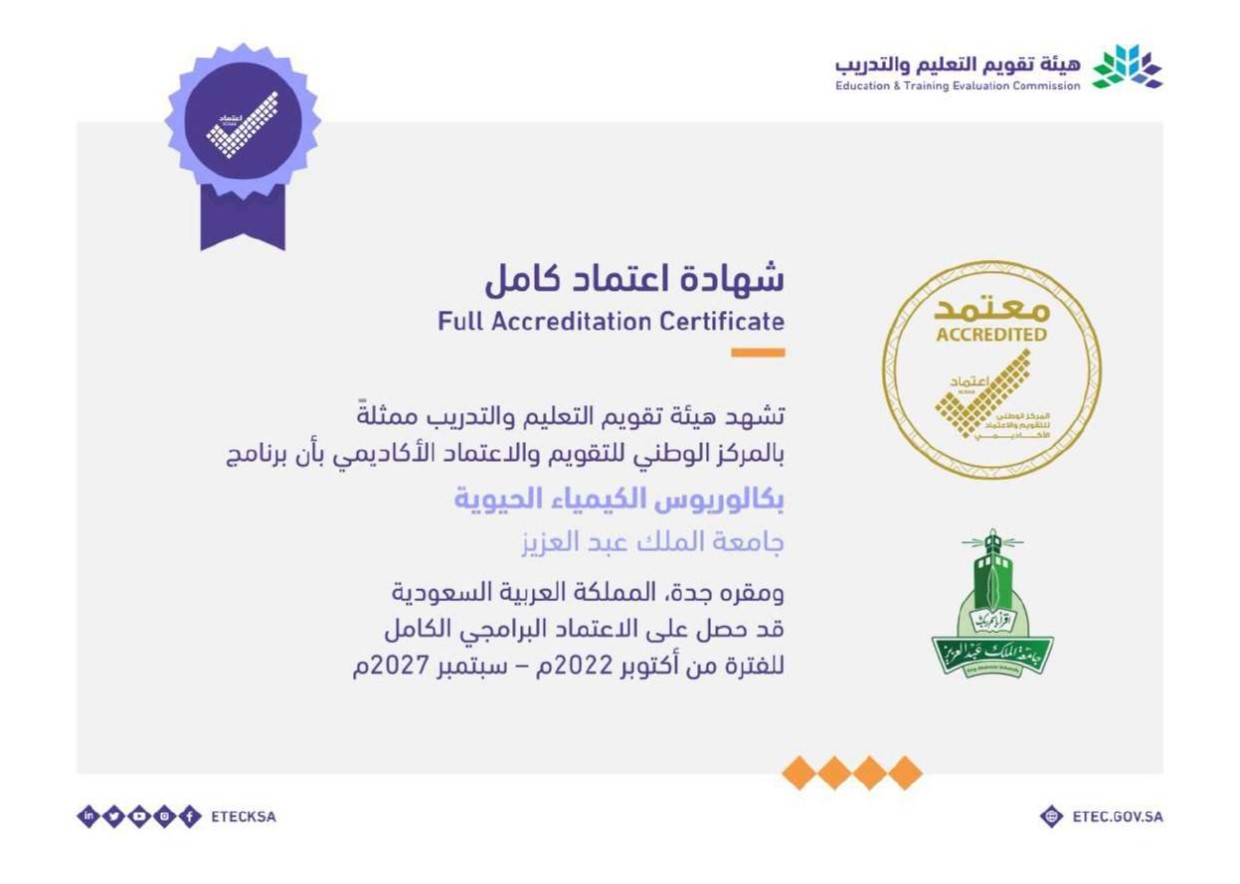
20260412890The bachelor's program in biochemistry is one of the pioneering and distinguished programs in the Faculty of Science at King Abdulaziz University, as those affiliated with this program will experience a scientific and practical experience with high standards that will make them distinguished scientists and productive citizens. The program covers a wide range of basic skills in biochemistry, chemistry, and biology. It also allows students to pursue their aspirations and practical and knowledge-based goals by providing various optional study materials. The program is periodically reviewed to update and develop it to meet labour market needs, ensure community service, and achieve the goals of the Kingdom's Vision 2030. The student must successfully pass all preparatory year courses to be accepted in the Biochemistry BSc program.

Leadership in education, scientific research and community.
Building an effective individual in the society through an educational and research environment based on modern foundations.
Last Modified Date: 14/06/2026 - 2:58 PM Saudi Arabia Time
| Course Code | Course | Credits | Prerequisites |
|---|---|---|---|
| MATH 110 | General Mathematics (1) | 3 | None |
| PHYS 110 | General Physics 1 | 3 | None |
| CPIT 100 | Computer Science | 3 | None |
| ELIS 110 | English Language 1 | 3 | None |
Course Code: MATH 110
Course Code: PHYS 110
Course Code: CPIT 100
Course Code: ELIS 110
| Course Code | Course | Credits | Prerequisites |
|---|---|---|---|
| BIO 110 | General Biology (1) | 3 | None |
| Description | A course is designed as a preparatory curriculum for Science track in Biology, paving for admission to medical and science colleges at KAU. The course offers an introductory course to general Biology focusing on the major topics for life sciences. | ||
| ELIS 120 | English Language 2 | 3 | None |
| CHEM 110 | General Chemistry I | 3 | None |
| STAT 110 | Statistics 1 | 3 | None |
Course Code: BIO 110
Description
A course is designed as a preparatory curriculum for Science track in Biology, paving for admission to medical and science colleges at KAU. The course offers an introductory course to general Biology focusing on the major topics for life sciences.
Course Code: ELIS 120
Course Code: CHEM 110
Course Code: STAT 110
| Course Code | Course | Credits | Prerequisites |
|---|---|---|---|
| BIOC 200 | Laboratory Safety and Security | 1 | None |
| Description | Study and learn about the different sources of hazardous materials in laboratories, how to avoid risks, and how to work in a safe area. Students should also be informed about the general laboratory safety procedures. | ||
| BIO 281 | General Biology Lab | 1 | BIO 110 |
| Description | This laboratory course is designed to reinforce the fundamental concepts of biology through practical experiments and scientific observation. It covers laboratory safety, microscopy techniques, cell structure, biological molecules, enzyme activity, cell division, genetics, biodiversity, and basic physiological and ecological investigations. The course emphasizes experimental design, accurate data collection, analysis and interpretation of results, scientific report writing, and the development of essential laboratory skills in accordance with good laboratory practices | ||
| BIO 202 | General Biology (2) | 4 | BIO 110 |
| Description | This course builds upon the concepts introduced in General Biology (1) and provides an integrated study of the diversity, structure, function, and interactions of living organisms. It covers plant and animal biology, physiology, ecology, evolution, biodiversity, population biology, ecosystems, and the principles of environmental sustainability. The course emphasizes the relationships between organisms and their environments, biological adaptation, and the application of biological principles to address environmental and societal challenges | ||
| BIOC 201 | General Biochemistry | 4 | BIO 110 |
| Description | Knowledge of the fundamentals of biochemistry at the molecular level, including the basic principles, concepts, and terminology in the field of biochemistry. | ||
| CHEM 202 | General Chemistry II | 4 | CHEM 110 |
Course Code: BIOC 200
Description
Study and learn about the different sources of hazardous materials in laboratories, how to avoid risks, and how to work in a safe area. Students should also be informed about the general laboratory safety procedures.
Course Code: BIO 281
Description
This laboratory course is designed to reinforce the fundamental concepts of biology through practical experiments and scientific observation. It covers laboratory safety, microscopy techniques, cell structure, biological molecules, enzyme activity, cell division, genetics, biodiversity, and basic physiological and ecological investigations. The course emphasizes experimental design, accurate data collection, analysis and interpretation of results, scientific report writing, and the development of essential laboratory skills in accordance with good laboratory practices
Course Code: BIO 202
Description
This course builds upon the concepts introduced in General Biology (1) and provides an integrated study of the diversity, structure, function, and interactions of living organisms. It covers plant and animal biology, physiology, ecology, evolution, biodiversity, population biology, ecosystems, and the principles of environmental sustainability. The course emphasizes the relationships between organisms and their environments, biological adaptation, and the application of biological principles to address environmental and societal challenges
Course Code: BIOC 201
Description
Knowledge of the fundamentals of biochemistry at the molecular level, including the basic principles, concepts, and terminology in the field of biochemistry.
Course Code: CHEM 202
| Course Code | Course | Credits | Prerequisites |
|---|---|---|---|
| BIO 231 | General Microbiology | 3 | BIO 202 |
| Description | Knowledge of enzymatic catalysis and inhibition, biological functions, and the kinetics and mechanisms of enzyme action. | ||
| BIOC 211 | General Metabolism (1) | 4 | BIOC 201 |
| Description | Learn and understand the major metabolic pathways of carbohydrates and lipids, their biochemical significance in the metabolic map, and the metabolic diseases associated with them. | ||
| BIOC 231 | Enzymes | 3 | BIOC 201 |
| Description | Focuses on understanding enzymatic catalysis and inhibition, biological functions, and the kinetics and mechanisms of enzyme action. | ||
| CHEM 281 | General Chemistry Lab | 1 | CHEM 110 |
| CHEM 230 | Organic Chemistry | 4 | CHEM 110 |
| Description | This course introduces the fundamental principles of organic chemistry with emphasis on the structure, nomenclature, properties, and reactions of carbon-containing compounds. It covers bonding and molecular geometry, stereochemistry, hydrocarbons, alkyl halides, alcohols, ethers, aldehydes, ketones, carboxylic acids and their derivatives, amines, aromatic compounds, and basic reaction mechanisms. The course also highlights the relationship between molecular structure and chemical reactivity, with applications in biological systems, pharmaceuticals, and industrial chemistry | ||
| ISLS 101 | Islamic Studies I | 2 | None |
Course Code: BIO 231
Description
Knowledge of enzymatic catalysis and inhibition, biological functions, and the kinetics and mechanisms of enzyme action.
Course Code: BIOC 211
Description
Learn and understand the major metabolic pathways of carbohydrates and lipids, their biochemical significance in the metabolic map, and the metabolic diseases associated with them.
Course Code: BIOC 231
Description
Focuses on understanding enzymatic catalysis and inhibition, biological functions, and the kinetics and mechanisms of enzyme action.
Course Code: CHEM 281
Course Code: CHEM 230
Description
This course introduces the fundamental principles of organic chemistry with emphasis on the structure, nomenclature, properties, and reactions of carbon-containing compounds. It covers bonding and molecular geometry, stereochemistry, hydrocarbons, alkyl halides, alcohols, ethers, aldehydes, ketones, carboxylic acids and their derivatives, amines, aromatic compounds, and basic reaction mechanisms. The course also highlights the relationship between molecular structure and chemical reactivity, with applications in biological systems, pharmaceuticals, and industrial chemistry
Course Code: ISLS 101
| Course Code | Course | Credits | Prerequisites |
|---|---|---|---|
| BIOC 301 | Inorganic Biochemistry | 2 | BIOC 231 |
| Description | Study of essential minerals, nonmetals, and trace elements in living organisms and their chemical transformations. | ||
| BIOC 312 | General Metabolism (2) | 3 | BIOC 211 |
| Description | Understanding the metabolism of proteins and nucleotides. In addition, it discusses the metabolic pathways of amino acids and distinguishes between the biosynthesis (anabolism) and breakdown (catabolism) of amino acids and nucleic acids. | ||
| BIOC 314 | Nutritional Biochemistry | 3 | BIOC 231 |
| Description | Study of the six classes of essential nutrients for health, including their dietary sources, digestion and absorption, transport mechanisms, major functions, recommendations, deficiency symptoms, and their effects on health. It also includes knowledge of the fundamentals of energy balance, weight management, and the design of a healthy diet. | ||
| BIOC 331 | Bioenergetics | 2 | BIOC 231 |
| Description | Understanding the principles of bioenergetic pathways in living organisms through knowledge of energy systems and cellular respiration. | ||
| BIO 222 | Cell Biology | 3 | BIO 110 |
| Description | This course provides students with a comprehensive understanding of the structure, organization, and function of cells as the fundamental units of life. It covers cell structure and organelles, membrane organization and transport, cell signaling, the cytoskeleton, cell division, cell cycle regulation, gene expression, protein synthesis, cellular metabolism, apoptosis, and cell communication. The course emphasizes the relationship between cellular processes and organismal function while introducing modern techniques used in cell biology research | ||
| ISLS 201 | Islamic Studies II | 2 | ISLS 101 |
| ARAB 201 | Arabic II | 3 | ARAB 101 |
Course Code: BIOC 301
Description
Study of essential minerals, nonmetals, and trace elements in living organisms and their chemical transformations.
Course Code: BIOC 312
Description
Understanding the metabolism of proteins and nucleotides. In addition, it discusses the metabolic pathways of amino acids and distinguishes between the biosynthesis (anabolism) and breakdown (catabolism) of amino acids and nucleic acids.
Course Code: BIOC 314
Description
Study of the six classes of essential nutrients for health, including their dietary sources, digestion and absorption, transport mechanisms, major functions, recommendations, deficiency symptoms, and their effects on health. It also includes knowledge of the fundamentals of energy balance, weight management, and the design of a healthy diet.
Course Code: BIOC 331
Description
Understanding the principles of bioenergetic pathways in living organisms through knowledge of energy systems and cellular respiration.
Course Code: BIO 222
Description
This course provides students with a comprehensive understanding of the structure, organization, and function of cells as the fundamental units of life. It covers cell structure and organelles, membrane organization and transport, cell signaling, the cytoskeleton, cell division, cell cycle regulation, gene expression, protein synthesis, cellular metabolism, apoptosis, and cell communication. The course emphasizes the relationship between cellular processes and organismal function while introducing modern techniques used in cell biology research
Course Code: ISLS 201
Course Code: ARAB 201
| Course Code | Course | Credits | Prerequisites |
|---|---|---|---|
| BIOC 315 | Metabolism Regulation | 2 | BIOC 312 |
| Description | Understanding the application of physics in the study of biological problems. | ||
| BIOC 341 | Physical Biochemistry | 3 | BIOC 231 |
| Description | Understanding the principles of bioenergetic pathways in living organisms through knowledge of energy systems and cellular respiration. | ||
| BIOC 343 | Analytical Biochemistry | 4 | BIOC 231 |
| Description | Providing the basic principles for understanding modern instruments and their applications in biotechnology and biochemistry laboratories. | ||
| BIOC 380 | Labor Market Skills | 3 | None |
| Elective-1 | Elective BIOC Course-1 | 2 | None |
| Elective-2 | Elective BIOC Course -2 | 2 | None |
| ISLS 301 | Islamic Studies III | 2 | ISLS 201 |
Course Code: BIOC 315
Description
Understanding the application of physics in the study of biological problems.
Course Code: BIOC 341
Description
Understanding the principles of bioenergetic pathways in living organisms through knowledge of energy systems and cellular respiration.
Course Code: BIOC 343
Description
Providing the basic principles for understanding modern instruments and their applications in biotechnology and biochemistry laboratories.
Course Code: BIOC 380
Course Code: Elective-1
Course Code: Elective-2
Course Code: ISLS 301
| Course Code | Course | Credits | Prerequisites |
|---|---|---|---|
| BIOC 416 | Clinical Biochemistry | 4 | BIOC 315 |
| Description | Introduction to the principles and procedures of the various tests performed in clinical chemistry, with a focus on biochemical laboratory techniques. | ||
| BIOC 432 | Molecular Biochemistry | 3 | BIOC 231 |
| Description | Understanding the molecular structure of nucleic acids; DNA replication, transcription, translation, types of mutations, molecular cloning, DNA sequencing, and the principles of common molecular techniques. | ||
| BIOC 491 | Research Project in Biochemistry | 3 | Department approval |
| Description | Training in conducting scientific research and in writing and discussing research results. | ||
| Elective-3 | Elective BIOC Course-3 | 2 | None |
| Elective-4 | Elective BIOC Course-4 | 2 | None |
| Free courses | The student chooses a course from the list of elective courses in the department | 3 | None |
Course Code: BIOC 416
Description
Introduction to the principles and procedures of the various tests performed in clinical chemistry, with a focus on biochemical laboratory techniques.
Course Code: BIOC 432
Description
Understanding the molecular structure of nucleic acids; DNA replication, transcription, translation, types of mutations, molecular cloning, DNA sequencing, and the principles of common molecular techniques.
Course Code: BIOC 491
Description
Training in conducting scientific research and in writing and discussing research results.
Course Code: Elective-3
Course Code: Elective-4
Course Code: Free courses
| Course Code | Course | Credits | Prerequisites |
|---|---|---|---|
| Elective-5 | Elective BIOC Course-5 | 3 | None |
| Elective-6 | Elective BIOC Course-6 | 3 | None |
| Elective-7 | Elective BIOC Course-7 | 3 | None |
| Elective-8 | Elective BIOC Course-8 | 4 | None |
| ISLS 401 | Islamic Studies IV | 2 | ISLS 301 |
Course Code: Elective-5
Course Code: Elective-6
Course Code: Elective-7
Course Code: Elective-8
Course Code: ISLS 401