Website belongs to an official educational in the Kingdom of Saudi Arabia always ends with .edu.sa
Secure websites in the Kingdom of Saudi Arabia use the HTTPS protocol for encryption.
Registered with the Digital Government Authority under number:
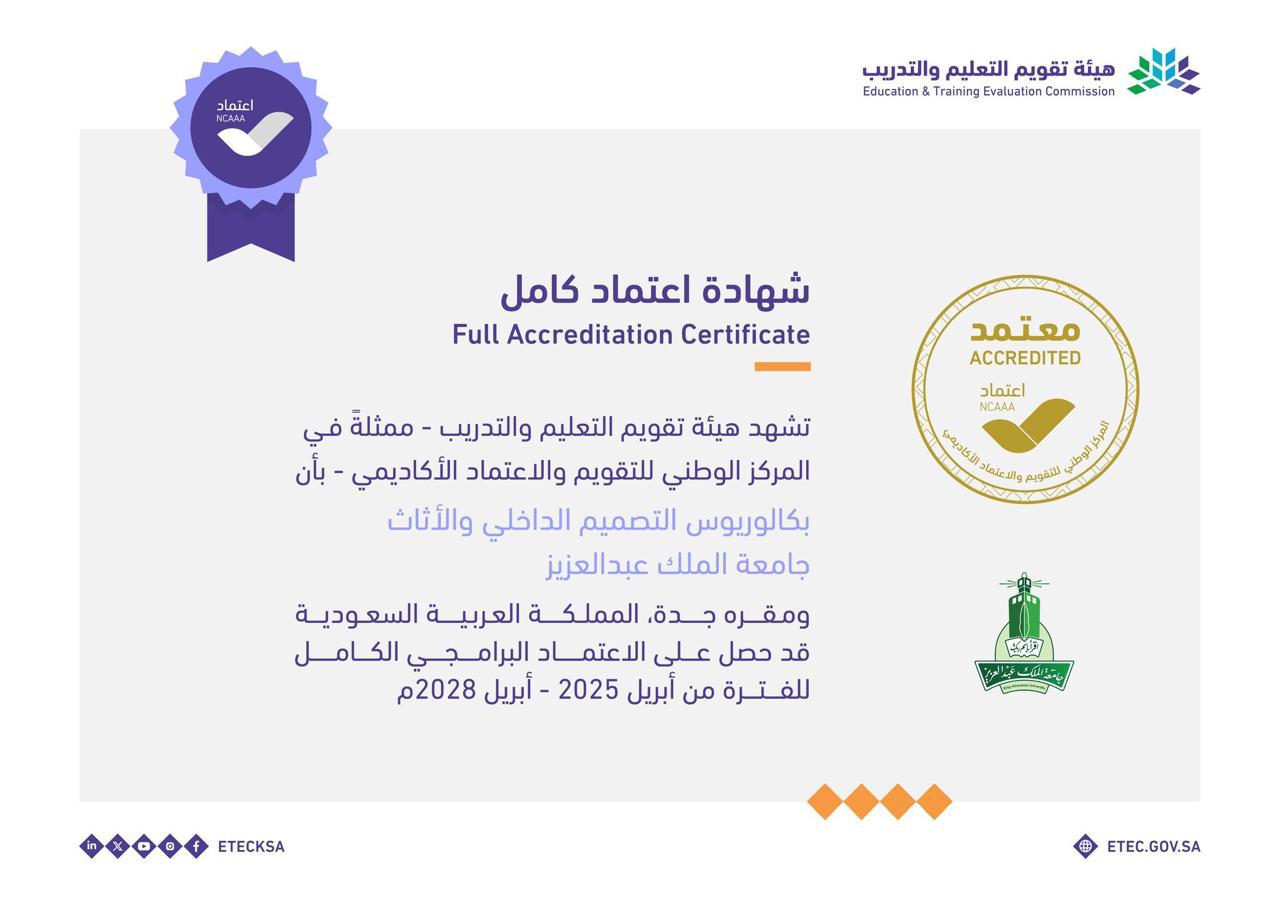
20260412890The program awards the Bachelor of Science in Interior Design and Furniture. It aims to prepare qualified graduates with design, research, and innovation skills to meet labor market needs and contribute to society through the creation of sustainable, functional, and aesthetically pleasing interior environments.

Leadership and excellence in education, research, and innovation in the field of Interior Design and Furniture, achieving competitiveness at both the national and international levels.
To prepare distinguished graduates equipped with research and innovation skills, demonstrating professionalism and creativity to meet the needs of the labor market in the field of Interior Design and Furniture.
Last Modified Date: 06/07/2026 - 5:21 PM Saudi Arabia Time
| Course Code | Course | Credits | Prerequisites |
|---|---|---|---|
| ID 408 | Interior Design Studio 8 senior project | 5 | ID 407 ID 439 |
| Description | In this course, students will design the project proposed in the research conducted previously in the Senior Project Research course. They will learn how to set goals and strategies to solve design problems in the project, and how to translate the results of the research analysis into the development and evaluation of design alternatives. These designs will reflect the student's personality and design identity, which have been shaped through the knowledge and skills acquired in all areas of interest in the department's curriculum, to produce an interior design that meets functional, aesthetic, and environmental requirements. The course includes practical interior design skills, with the project space being no less than 2500 square meters in one of the interior design fields, subject to the approval of the course supervisor. | ||
| ID 454 | Professional Practice | 3 | ID 251 |
| Description | The course covers the study of professional practices in a practical context and the analysis of design projects. This includes identifying the needs of the labor market, conditions, specifications, contracts, employment of workers, and client contracting in various fields to practice interior design professionally in consulting offices, production units, and specialized exhibitions. | ||
| ID 142 | Materials Uses and Techniques | 3 | ID 142 |
| Description | The course covers detailed studies on the use of sustainable local and global finishing materials in the interior and exterior spaces of various facilities. It also discusses the criteria for selecting such materials in interior design projects. | ||
| ID 143 | Principles of Structure | 3 | – |
| Description | The course explores the structural elements that make up architectural spaces, as well as the construction methods and systems related to them. It covers the entire construction process, from site selection and analysis to finishing, while also examining sustainable building systems and the requirements for implementing and finishing interior space elements. The application of these concepts is examined in architectural projects across a range of facilities. | ||
| ID 203 | Interior Design studio (3): Residential projects | 3 | ID 102: |
| Description | This course focuses on exploring the humanitarian aspects of residential projects. Through theoretical and analytical studies, the course aims to address design problems related to functionality, environment, and aesthetics. The ultimate goal is to create a livable and comfortable environment for human habitation. | ||
| ID 218 | Furniture Design 1 | 5 | ID 131 |
| Description | The course of Furniture Design 1 introduces the student to the principles of furniture design throughout various ages, starting from ancient Egyptian times, passing through subsequent eras, up to our current era. This aims to teach the student how to apply design principles and aesthetic standards in furniture. The curriculum focuses on imparting knowledge and skills to the student so that they can design successful furniture pieces that meet international manufacturing specifications. They undergo the complete design process from conceptualization to initial production under the required basic standards. | ||
| ID 232 | History and Theories of interior Design and Furniture 2 | 3 | ID 131 |
| Description | The course covers the study of the history of interior design, furniture, and architecture in the Middle Ages, as well as the design terminology of Islamic architecture from the Umayyad era to the Ottoman era. The course also addresses the study of interior design and furniture of the Renaissance, including English and French styles. It also examines and analyzes the trends and theories of Western architecture - the beginning of the Industrial Revolution in Europe - 19th- century architecture - the arts and crafts movement - the new art movement, especially in Belgium and Spain - the beginnings of fine arts - modern architectural education and schools - Art Deco - Functionalism - Organic School - Postmodern School, and the study of the works of early pioneers in those periods, focusing on the connection between architectural production and interior design and furniture, along with a review of the local style of the Kingdom of Saudi Arabia in its various regions. | ||
| ID 222 | Visual Communication in Interior Design | 3 | ID 102 ID 121 |
| Description | This course teaches the skills to develop and express ideas manually and technically, starting from learning the basics of drawing with pencils and ink, coloring, and Rapid Viz drawing, to advanced methods for presenting ideas, such as presentations and posters. It also teaches the basics of professional software that is specialized in publishing, designing the layout of pages, and presentation boards, as well as software specialized in image editing and raster graphics. | ||
| ID 204 | Interior Design Studio 4: Institutional Projects | 4 | ID 203 |
| Description | The course focuses on the interior design of institutional buildings, with an emphasis on sustainability principles. These principles aim to enhance the health and well-being of users, promote social aspects, and reduce the environmental impact of construction. Students will learn methods to achieve these principles when designing interior spaces of institutional buildings. They will also learn how to measure aspects like indoor air quality, thermal comfort, sound quality, ventilation, and more. By the end of the course, students are expected to produce creative design solutions that integrate sustainability into the interior spaces of institutional buildings. | ||
| ID 232 | History and Theories of interior Design and Furniture 2 | 3 | ID 131 |
| Description | The course covers the study of the history of interior design, furniture, and architecture in the Middle Ages, as well as the design terminology of Islamic architecture from the Umayyad era to the Ottoman era. The course also addresses the study of interior design and furniture of the Renaissance, including English and French styles. It also examines and analyzes the trends and theories of Western architecture - the beginning of the Industrial Revolution in Europe - 19th- century architecture - the arts and crafts movement - the new art movement, especially in Belgium and Spain - the beginnings of fine arts - modern architectural education and schools - Art Deco - Functionalism - Organic School - Postmodern School, and the study of the works of early pioneers in those periods, focusing on the connection between architectural production and interior design and furniture, along with a review of the local style of the Kingdom of Saudi Arabia in its various regions. | ||
| ID 233 | Human factors | 3 | – |
| Description | The course includes studying the mutual interaction between humans and interior space, by recognizing the fundamental concepts of human factors and diverse capabilities related to objective measurements, human dimensions, and various work environments. Additionally, it examines the psychological, social, functional, and cultural needs of different groups of people and their impact on human perception, quality of life, and their connection to human rights through a theoretical and practical educational approach. This helps prepare students to confront complex design challenges | ||
| ID 204 | Interior Design Studio 4: Institutional Projects | 4 | ID 203 |
| Description | The course focuses on the interior design of institutional buildings, with an emphasis on sustainability principles. These principles aim to enhance the health and well-being of users, promote social aspects, and reduce the environmental impact of construction. Students will learn methods to achieve these principles when designing interior spaces of institutional buildings. They will also learn how to measure aspects like indoor air quality, thermal comfort, sound quality, ventilation, and more. By the end of the course, students are expected to produce creative design solutions that integrate sustainability into the interior spaces of institutional buildings. | ||
| ID 223 | Computer Applications | 4 | ID 222 |
| Description | This course covers computer-aided design (CAD) programs and 2D/3D visualization techniques for interior design. It aims to produce professional engineering drawings and realistic visualizations using software, enhancing visual communication. | ||
| ID 245 | Environmental Control Systems | 3 | ID 143 |
| Description | The course provides a comprehensive understanding of the Earth's environment, climate, and different types of terrains. It covers the importance of environmental balance and the consequences of global warming, including its causes, and the proliferation of industrial farms. The course then moves on to focus on environmental control systems within buildings, including thermal, lighting, acoustic, natural, and industrial ventilation control systems, as well as technological systems and smart homes | ||
| ID 244 | Lighting in interior design | 3 | – |
| Description | The course focuses on the application of natural and artificial lighting design principles. It covers the study of design requirements and factors affecting the actual distribution of lighting intensity. Additionally, the course includes the study of lighting design stages in interior spaces and calculation of the required number of lighting units for a space based on its function through a practical project. | ||
| غ ت 401 | Workforce Skills | 3 | – |
| ID 252 | Summer Training 1 | 1 | ID 204 |
| ID 121 | Architectural Drawing | 3 | – |
| Description | This course provides a comprehensive understanding of the fundamental principles and different types of architectural drawings, both for two and three dimensions. It covers the basics of architectural drawing through the study of architectural processes, as well as the principles of vertical and horizontal projections, which are used to express design ideas for interior spaces. The course includes learning how to draw floor plans, sections and elevations, and architectural details. It also focuses on developing the manual skills and presentation techniques to produce architectural drawings and models. | ||
| ID 101 | Interior Design Studio 1: Fundamentals 1 | 3 | – |
| Description | An introductory course that equips students with the fundamental knowledge and cognitive skills necessary to understand the elements of interior design, design principles, and manual drawing skills. Students will learn about abstraction formations, spatial and volumetric organizational principles, and visual formations. The course also covers the practical application of these skills and knowledge in the creation of two-dimensional designs and formations. | ||
| ID 141 | Color and Light | 3 | – |
| Description | The course aims to provide a comprehensive understanding of the basic concepts in the area of color design in general. The topics covered in the course include color theories and their various interactions in diverse spaces, with a particular emphasis on interior design. This entails understanding how color interacts with light under different circumstances. The course is designed to equip students with the skills they need to select appropriate color schemes for their designs. | ||
| ID 102 | Interior Design Studio 2: Fundamentals 2 | 3 | ID 101 |
| Description | This is a foundational course that teaches the concepts and basic skills of three- dimensional design. The course covers volume, shape, space, direction, and value, and how to use them to create three-dimensional designs. Students learn how to analyze, compose, design, scale, and understand human proportions. The course emphasizes practical projects to help students develop visual perception of spatial volume and the main principles of shaping and designing it. Students also learn to apply these principles in three-dimensional formations and compositions, linking them to external shaping and the surrounding environment. Additionally, the course covers different methods of three-dimensional drawings such as isometric, axonometric, one-point, and two-point perspective, as well as various manual rendering techniques. | ||
| ID 131 | History and Theories of Interior Design and Furniture 1 | 3 | – |
| Description | This course is an introductory course that covers the principles and theories of design. It emphasizes the nature of design, its vocabulary, basic concepts, and design elements. The course focuses on abstract formations in two and three dimensions and their practical applications. It also covers the principles of design in general and various organizational methods. The course further explores the history of architecture, interior design, and furniture starting from primitive times, through the Egyptian, Greek, Roman, and Coptic eras. Students will learn to identify the characteristics and features of each style to distinguish the styles of interior design and furniture elements between different eras. | ||