The program is designed to meet labor market needs fully and is subject to continuous updates and developments based on demand assessments. It focuses on equipping students with a high level of knowledge and practical skills, enabling them to design and implement planning projects at various levels. Graduates of the program have contributed to meeting the demand for job opportunities in municipalities, regional and rural municipalities, national government agencies, ministries and departments, private consulting firms, real estate development companies, and research and academic institutions. They have also contributed to developing and improving the efficiency of urban growth management, development monitoring, and improving living conditions in urban and rural communities in the Kingdom of Saudi Arabia.
The program also aims to introduce students to the nature of human settlements, their social, economic, and physical aspects, and to address existing, emerging, and anticipated problems in light of planning theories, strategies, and techniques. The curriculum equips students with the necessary skills to implement spatial development plans at the local, regional, and national levels for both urban and rural communities, including how to address, rehabilitate, develop, and improve informal settlements and slum areas in cities. The Bachelor of Science in Urban and Regional Planning program was originally designed by a team of specialists from Harvard University as a six-year program requiring 182 credit hours for graduation. The program was initially divided into three years of core and three years of specialization. In 1999, the college transitioned to a new, enhanced program consisting of 165 credit hours, completed in five years, in response to labor market demands and graduate feedback. In the first semester of the 2014/2015 academic year, a new curriculum was adopted, reducing the required credit hours for graduation to 155. Under this new curriculum, students are admitted directly to their departments after successfully completing the university preparatory year, in accordance with national education policies and international standards. Starting in the current academic year (2016/2017), the program has been offered under an enhanced curriculum of 165 credit hours, and a bridging program to the Bachelor of Science degree, based on this new curriculum, was implemented in the second semester of the same year (2016/2017).
Last Modified Date: 26/07/2026 - 4:50 PM Saudi Arabia Time
Vision & Mission
Vision
The Department of Urban and Regional Planning should be a leading center for education, research, and creativity in the field of urban planning.
Mission
To be a platform for training creative graduates at a global level in urban planning sciences to serve the community and the local market and achieve environmental sustainability.
Program Goals
1Updating the bachelor's program at the level of international universities.
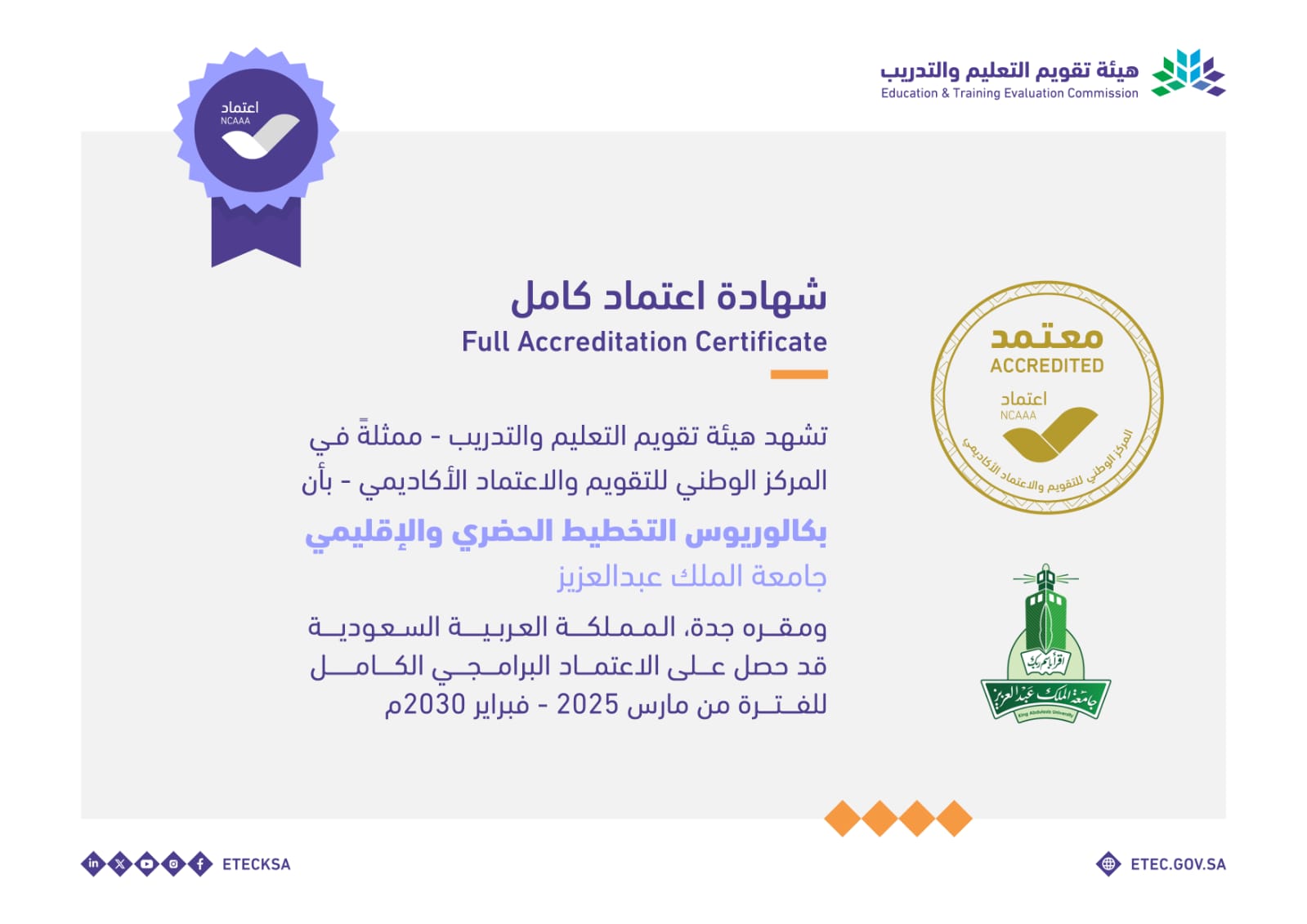
2Achieving academic accreditation for the bachelor's program.
3Activating student research cooperation at local and international levels.
4Motivate participation in local and international educational platforms to develop the level of faculty members.
5Focusing on the development of learning outcomes to raise the efficiency of the student.
6Activate the links between the program and graduates to develop the discipline.
7Develop students' knowledge and sciences before and after graduation.
8The program should be a house of expertise to serve the community.
9Develop professional solutions that achieve environmental sustainability.
10Finding and investing effective cooperation with public and private sector institutions at local and global levels.
Learning Outcomes
Knowledge:
Discuss in-depth the evolution of planning thoughts and theories of regional and urban planning
Review the techniques, terms, and practices associated with the urban and regional planning practices dealing with legal, political, social, economic, and environmental processes
Explain the up-to-date functions, regulations, and technical requirements for urban and regional plans at local and global scales
Recognize research and inquiry methodologies operable in Urban and Regional Planning
Skills:
Apply the planning theories to scrutinize complex urban issues and patterns aimed at sustainable planning and designing of the social, economic, and environmental aspects of a city
Propose innovative and optimal planning and design alternatives to solve problems of public open spaces, urban greening, housing, transportation, and urban renewal among others
Produce innovative approaches, strategies, policies, plans and designs through fitting critical thinking processes about the real-world complexities that underlie the Sustainable Development
Graduate Attributes
Solve complex planning problems professionally and ethically.Show effective performance within a team environment.LeadershipProject management skillsMastering the use of information and telecommunication technologies.Effective communicationsLifelong learningCultural competencyIndependence and proactiveResilience and adaptation
Career Opportunities
Graduates of the Urban and regional planning Department have access to employment opportunities in the private, public, academic, and non-profit sectors.
Many of our graduates work in architectural, civil engineering, and urban planning firms, as well as contracting companies. They participate in diverse design, planning, and construction projects related to urban planning, such as parks and gardens, urban and residential development, and commercial space design. Our graduates also have ample job opportunities in the government and semi-government sectors, including the Royal Commission for Regional Development, the Ministry of Municipal and Rural Affairs, the Ministry of Hajj and Umrah, the Ministry of Health, the Ministry of Environment, Water and Agriculture, the Ministry of Culture, and the Ministry of Tourism, in addition to major new projects associated with Vision 2030.
Job opportunities for urban planning engineers have increased significantly with the launch of Saudi Vision 2030, which aims to diversify the national economy and develop public service sectors such as health, education, infrastructure, entertainment, and tourism. Vision 2030 is being realized through ambitious programs (such as the Quality of Life Program, the Housing Program, and the Public Investment Fund Program), projects (such as NEOM, the Red Sea Development Project, Al-Ula, King Salman Park, Jeddah City Center, the Diriyah Gate Project, and the Riyadh Green Project), and initiatives (such as the Saudi Green Initiatives). Our graduates and faculty members are making significant contributions to achieving this vision.
Study Plans & Courses
The College Requirements for the bachelor's degree aim to establish a solid academic foundation in the disciplines of Architecture and Planning by equipping students with fundamental concepts and theories, developing their design skills, and enabling them to use relevant technical tools. They also prepare students for specialized study and enhance their ability to apply their knowledge effectively in practical contexts.
Examine and investigate present-day built environment issues through state-of-the-art planning research methods
Practice and adapt document analysis, spatial and non-spatial analytical tools, advanced planning and designing methods, and technologies to tackle complex urban planning and designing challenges
Demonstrate urban planning and urban designing tasks to minimize climate change risks, maximize livability & Quality of Life, and optimize the economic performance of cities and regions
Demonstrate oral and written communication skills to analyze, interpret, and solve problems of sustainable urban development
Use mathematical operations and quantitative methods to process data and information in various complex scenarios of Urban and Regional Planning
Select and use ICT tools and applications aimed at dissemination of the outcomes of the research investigations and professional work
Values, Autonomy and Responsibility:
Demonstrate commitment to the professional field of urban and regional planning and follow academic values and standards and ethical code of conduct and represent responsible citizenship and coexistence with others while producing urban plans and urban design projects
Developing professional portfolios fit to become a prospective professional planning by self-development through competent projects and continuous learning
Demonstrate qualities of a planning leader with flexibility, effective self-management, negotiating, and persuasion
Set-up, collaborate and monitor teams to perform multidimensional urban planning tasks
Ensure their contribution for the progress of Urban and Regional Planning and Saudi society