Website belongs to an official educational in the Kingdom of Saudi Arabia always ends with .edu.sa
Secure websites in the Kingdom of Saudi Arabia use the HTTPS protocol for encryption.
Registered with the Digital Government Authority under number:
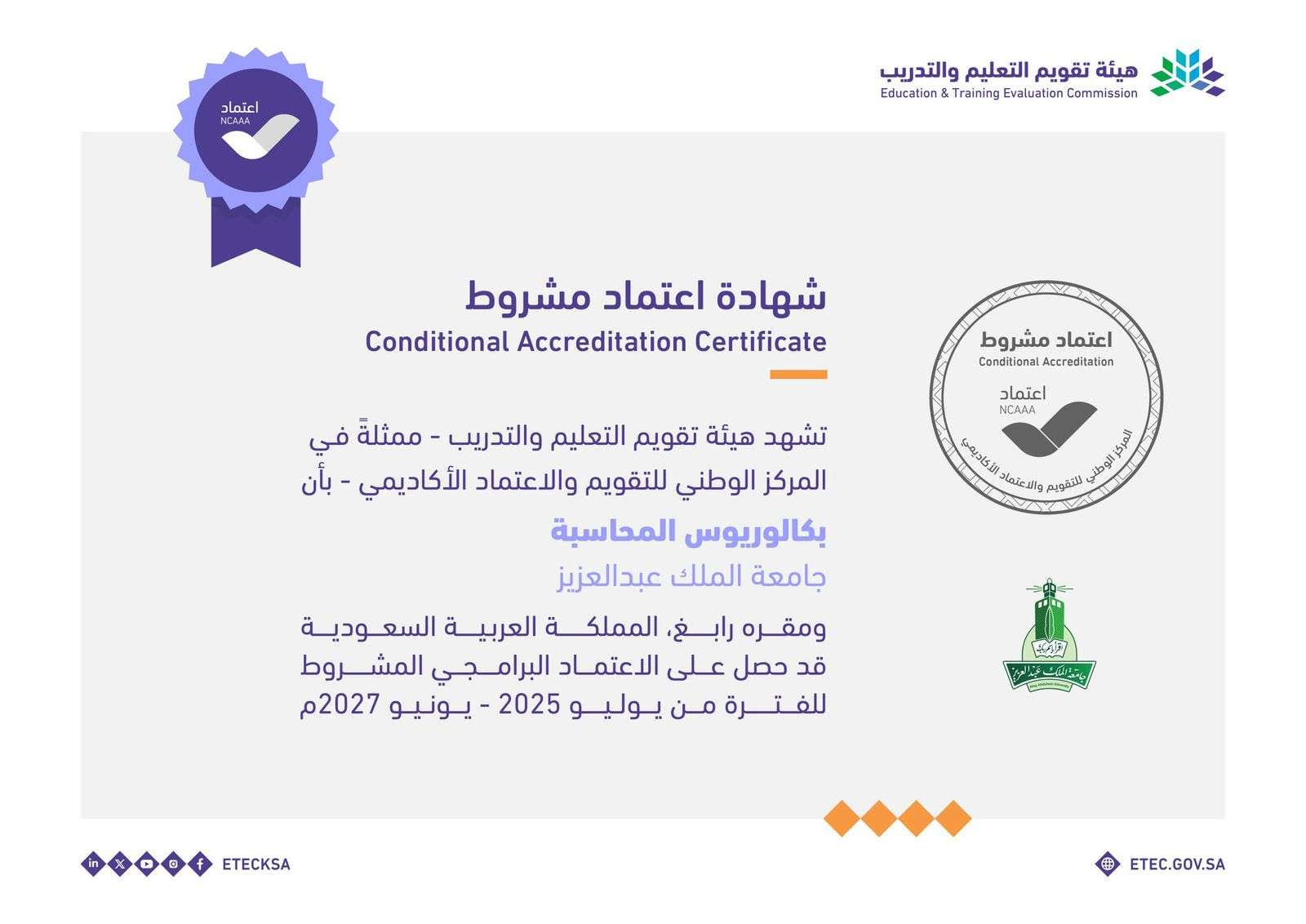
20260412890The Accounting Program is one of the first Programs established at the Faculty of Business in 1431 AH. , specializing in teaching students the fundamentals and concepts of financial and managerial accounting. The department aims to equip students with the knowledge and skills needed to understand and analyze financial data and prepare financial reports that help organizations make sound financial decisions. The department also focuses on training students to apply accounting principles in various work environments, including accounting in corporations, government institutions, and non-profit organizations. The Accounting Department emphasizes the development of students' skills in areas such as financial statement analysis, auditing, cost accounting, and tax accounting. It also strives to prepare students for specialized accounting fields such as corporate accounting, tax accounting, and financial auditing. The department aims to prepare graduates to work efficiently in the accounting field, whether in the private or public sector while adhering to the latest international standards in accounting and financial reporting.

To be a leader in education, scientific research, and community service in the field of accounting.
To provide high-quality education and applied research in the field of accounting that supports the goals of community development.
Last Modified Date: 23/07/2026 - 1:55 PM Saudi Arabia Time
| Course Code | Course | Credits | Prerequisites |
|---|---|---|---|
| ACC 253 | ACCOUNTING PRINCIPLES (1) | 3 | – |
| Description | This is an introductory course in financial accounting designed to equip the Students with the accounting skill needed to handle business transactions. It will concentrate on providing the student with essential understanding of the accounting concepts, rules, principles, bookkeeping techniques in demonstrating the Complete Accounting Cycle, adjusting the accounts and the preparation of financial statements for a service & merchandising company. It will also include the accounting for merchandizing company in both the periodic & perpetual System. Accounting for some current assets (inventory) will be covered. In brief this course will provide the students a strong foundation on which further area of accounting would be easier to understand if they choose accounting as major for their degree program | ||
| ACC 300 | Accounting principles II | 3 | ACC 253 |
| Description | This course is designed to familiarize students with accounting terminology and concepts. Building on the foundation gained in the accounting Principles I. This course integrates accounting principles and their applications to business objectives, financial statement preparation , flow of funds, current assets non-current assets, short-term liabilities, inventory methods and evaluation , and depreciation methods. | ||
| ACC 301 | Cost Accounting I | – | ACC 253 |
| Description | This course introduces the basic concepts of cost accounting and its relationship with other accounting fields. Cost terms and classifications. It also applies and account for job-order & process costing system & the activity costing system. Inventory costing approaches. It covers also overheads cost allocation methods, allocation of support- departments costs, joint cost allocation and the accounting treatment for spoilage, rework, scraps. | ||
| ACC 303 | Financial Statements Analysis | 3 | ACC 253 |
| Description | Based on the reality of the importance of financial analysis as a basic tools for decision makers , this course Presents the financial statement analysis tools and techniques from the point view of the primary users of financial statements. It covers the fundamental concepts of financial reporting, Applying basic analysis tools by using financial ratios for example (liquidity, profitability, paying ability, debt, market ratios), conduct capital structure analysis and studying trends, preparing cash flow statements and calculating the related ratios. | ||
| ACC 310 | Managerial accounting | 3 | ACC 253 |
| Description | An introductory course concerned with the use & analysis of financial and non-financial information in planning, control, managerial decision making and performance evaluation. Major topics include cost classification, cost behavior analysis, cost estimation, Cost-Volume-Profit relations (break even analysis). Also, it includes the relevant costs for decisions making, budgeting planning (preparing comprehensive budget), the Decentralization concept and responsibility accounting. Finally the capital budgeting decisions will be introduced. | ||
| ACC 304 | Cost Accounting II | 3 | ACC 301 |
| Description | This course will base on knowledge covered in cost accounting 1. It will concentrate on using cost information as a managerial tool for planning, decision making, controlling, and performance evaluation and will present also the modern techniques of cost accounting. Topics will include (CVP) analysis, master budget and flexible budget, direct and indirect - cost variances. Also it will cover the pricing decisions and cost management. Strategy and balance scorecard, quality improvement program costs, inventory management (EOQ), just in time system (JIT). | ||
| ACC 305 | Intermediate Accounting I | 3 | ACC 300 |
| Description | This course introduces the conceptual framework of financial accounting which rules the basics of accounting treatments for various enterprises' transactions. Examining the elements of the financial statements (income statements & balance sheet). In details it covers measurement problems of different types of assets, their evaluation, and their disclosure in financial statements. | ||
| ACC 413 | Accounting Information System | 3 | – |
| Description | This course covers the main components of accounting information system and its development life-cycle. It also covers the general framework of accounting internal control System for both manual and electronic accounting information System, auditing electronic System , designing of accounting information System for different process , also it will cover the different documentation techniques, the computer fraud , and the data processing cycle & database management , producing reports for internal or external users | ||
| ACC 411 | Intermediate Accounting II | 3 | ACC 305 |
| Description | This course covers the accounting issues related short and long liabilities, leases, stockholders’ equity, debts and equity investments. It's also cover revenue recognition in different situations and the accounting treatments for accounting principles changes & errors & estimates & economic entity change, and the presentation standards, full disclosure in financial reports. | ||
| ACC 412 | Auditing | 3 | ACC 305 |
| Description | This course introduces the auditing profession, its requirements, auditing standards, professional ethics, responsibilities and objectives of auditing. It also covers planning and implementing the audit process, and Studying and evaluating of internal control System .preparing auditing reports | ||
| ACC 416 | Corporate Accounting | 3 | ACC 300 |
| Description | Corporate Accounting ACCA 412 consider as important course to educate students about Formation of Partnership by cash, assets and introduce balance sheet for current firm ,Current Accounts for Partners ,Profit dividends for Partners ,Accounting for Joining new partners ,Accounting for Separation ,Corporation Accounting formation Profit dividends for Corporation and accounting for bonds. | ||
| ACC 417 | Accounting for Financial Institutions | 3 | ACC 416 |
| Description | This course focuses on accounting for commercial banks and Bank Accounting Systems, where we will discuss how to record banking operations performed by bank departments and how to prepare financial statements of the commercial banks. It also covers matters relating to cost systems; performance measurement applied to commercial banks and the new development in these areas. | ||
| ACC 418 | International Accounting | 3 | ACC 416 |
| Description | This course is designed as a course in principles of International Accounting at the undergraduate level. The course aims to introduce the subject to students. Therefore, it focuses on the reasons that create the need for International Accounting , types of Accounting standards. Furthermore, the course provides useful insights relating to how to record foreign currency transactions and how company can record and report this transactions , also course include hedging operations as future contracts , forward contracts and options , Course explain how mother company can translate subsidiary financial statements | ||
| ACC 419 | Accounting For Financial Institutions | 3 | ACC 411 |
| Description | This course introduces students to the accounting concepts and principles related to financial institutions, with emphasis on the nature of accounting operations in banks, insurance companies, and other financial organizations. It covers the recording and processing of financial transactions, preparation of financial statements and reports, and accounting systems and internal controls applied in financial institutions. The course also examines financial performance measurement, accounting treatments for revenues and expenses, financial risk management, and recent developments in financial institutions accounting. | ||
| ACC 420 | Research methods in Accounting | 3 | ACC 411 |
| Description | Research methods in accounting | ||
| ACC 491 | Co-Op training | 3 | Successful Completion Of 7 Semesters |
| Description | This course provides students with the opportunity to apply the accounting knowledge and skills acquired during their academic studies in a practical work environment. It focuses on training students in organizations related to the accounting field and familiarizing them with accounting procedures, systems, financial reporting, recording and analyzing accounting transactions, and the use of accounting software. The course also develops students’ professional skills, communication skills, teamwork abilities, problem-solving, and decision-making skills, preparing them for the accounting profession and the labor market. | ||

King Abdulaziz University Student Values Guide
The University Student Values Guide is an awareness initiative aimed at promoting positive behavior and institutional belonging among male and female students at King Abdulaziz University. It highlights the university’s core values that form the foundation for developing a well-rounded, responsible personality, academically, ethically, and socially. The guide seeks to instill a unified system of values that represent the pillars of academic and human conduct, including: Fear of Allah (Taqwa), Moderation and Balance, Tolerance and Coexistence, Honesty, Responsibility, Giving to the Nation, Learning, Respect, Quality and Leadership, and Appreciation of Family. It also provides practical guidelines that foster positive interaction within the university campus and digital learning environments, contributing to a culture of mutual respect, discipline, and excellence. This supports the university’s mission and aligns with Saudi Vision 2030 objectives in building human potential and advancing societal development.
University Student Guide: Rights and Responsibilities
The University Student Guide on Rights and Responsibilities is an official reference document that outlines the regulatory framework governing the relationship between the student and the university, reinforcing the principles of fairness, transparency, and shared responsibility within the academic environment. It aims to inform students of their academic, administrative, and service-related rights, and to clarify the duties and expected standards of conduct in accordance with approved university regulations and policies. The handbook also explains available support and guidance channels, as well as grievance procedures, enabling students to exercise their rights with awareness and responsibility. Ultimately, it contributes to fostering a safe and motivating educational environment that enhances the overall university experience and supports the achievement of intended learning outcomes.
Student Code of Conduct and Disciplinary Regulations King Abdulaziz University
Driven by King Abdulaziz University’s commitment to achieving its vision, mission, and strategic objectives, and to empowering students to fully benefit from its educational and research services, the University has developed the Student Conduct and Discipline Regulations in line with the Study and Examination Regulations issued by the Universities Affairs Council. These regulations reflect the University’s dedication to fostering a campus environment grounded in discipline, commitment, and shared responsibility. They aim to clearly define the nature of violations and the corresponding disciplinary actions, whether occurring on or off campus, in a manner that promotes transparency and ensures a safe, organized, and supportive educational environment that enhances the quality of university life and encourages adherence to values and responsibility.
Undergraduate Study and Examination Regulations and Implementing Rules at King Abdulaziz University
The Undergraduate Study and Examination Regulations and Implementing Rules at King Abdulaziz University serve as the primary regulatory reference governing the academic journey of students from admission to graduation. These regulations have been developed in alignment with the rules and policies approved by the Ministry of Education, while also taking into consideration the unique academic environment and specific needs of the University. The regulations aim to establish a comprehensive and clear framework for the educational process, covering admission and registration, study system, student assessment mechanisms, examinations, grading, transfer and withdrawal procedures, as well as graduation requirements. The associated implementing rules provide detailed mechanisms and procedures to apply the provisions of the regulations in practice, ensuring fairness, transparency, and consistency across all colleges and departments. Thus, these regulations represent an organizational and procedural tool that contributes to enhancing the efficiency of the educational process, achieving academic quality, and providing a balanced learning environment that enables students to achieve their academic goals in line with the mission and objectives of King Abdulaziz University and the Kingdom’s Vision 2030.